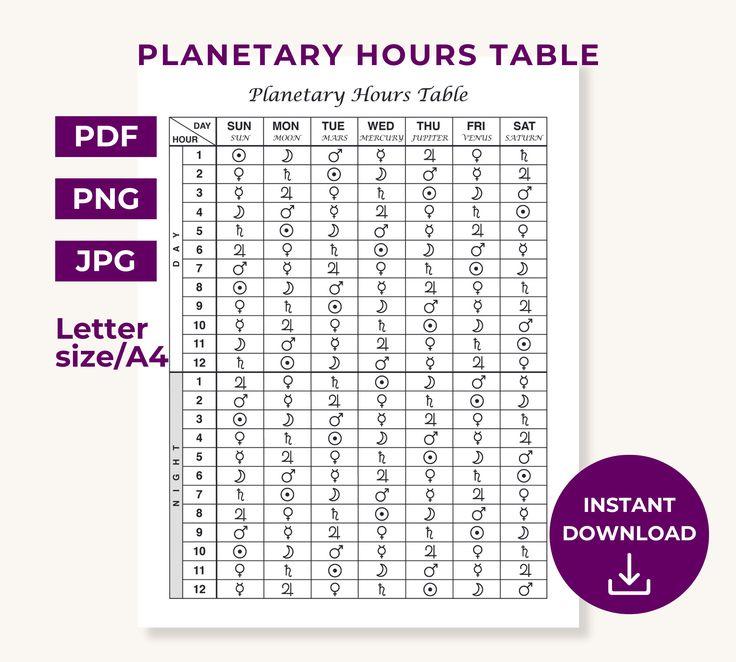
Planetary Hours Chart: Free Printable Reference Guide (PDF)
Planetary Hours Chart: Free Printable Reference Guide
A planetary hours chart is the single most useful reference tool for anyone working with the ancient system of planetary timing. Whether you're a seasoned astrologer or a curious beginner, having a clear, at-a-glance chart that shows the sequence of planetary rulers, their associated activities, and the weekly day-planet correspondences transforms planetary hours from an abstract concept into a practical, daily tool. This page provides a complete planetary hours reference in markdown table format that you can bookmark, print, or save as a PDF from your browser.
Download Printable Chart — open in your browser and use Print → Save as PDF for a permanent copy.
For real-time, location-specific planetary hour calculations, use our free Planetary Hours Calculator — it does the math for you automatically based on your local sunrise and sunset times.
What Is a Planetary Hours Chart?
A planetary hours chart is a visual reference showing which planet rules each hour of the day and night, following the ancient Chaldean Order. The system divides each day into 24 planetary hours — 12 daytime hours (sunrise to sunset) and 12 nighttime hours (sunset to the next sunrise) — with each hour ruled by one of the seven classical planets.
Unlike our modern 60-minute clock hours, planetary hours vary in length depending on the season and your latitude. In summer, when days are long, each daytime planetary hour stretches beyond 60 minutes, while nighttime hours shrink. In winter, the reverse is true. This is why a calculator is essential for exact timing — but the chart below tells you the sequence of rulers, which never changes.
For a thorough explanation of how planetary hours work, see our guide on What Are Planetary Hours?.
The Chaldean Order Explained
The foundation of every planetary hours chart is the Chaldean Order — the ancient sequence of the seven classical planets arranged by their apparent speed as observed from Earth, from slowest to fastest:
Saturn → Jupiter → Mars → Sun → Venus → Mercury → Moon
This sequence repeats endlessly throughout the hours of every day. The critical rule that ties the system together is this: the first hour after sunrise on any day is ruled by that day's planetary lord. From there, the Chaldean Order determines every subsequent hour.
Here's why the days of the week have the names they do:
| Day | Planetary Ruler | Origin of Name | |-----|----------------|----------------| | Sunday | ☉ Sun | Sun's day | | Monday | ☽ Moon | Moon's day | | Tuesday | ♂ Mars | Tiw's day (Norse Mars) | | Wednesday | ☿ Mercury | Woden's day (Norse Mercury) | | Thursday | ♃ Jupiter | Thor's day (Norse Jupiter) | | Friday | ♀ Venus | Frigg's day (Norse Venus) | | Saturday | ♄ Saturn | Saturn's day |
For a detailed exploration of how each day connects to its planet, see our guide on Planetary Days of the Week.
Complete Planetary Hours Chart: The 7×7 Matrix
The table below shows the ruling planet for each of the first seven daytime hours across all seven days of the week. After the seventh hour, the Chaldean Order continues cycling through hours 8–12 (daytime) and hours 1–12 (nighttime), always following the same Saturn → Jupiter → Mars → Sun → Venus → Mercury → Moon sequence.
Daytime Planetary Hours (Hours 1–7 After Sunrise)
| Hour | Sunday | Monday | Tuesday | Wednesday | Thursday | Friday | Saturday | |------|--------|--------|---------|-----------|----------|--------|----------| | 1 | ☉ Sun | ☽ Moon | ♂ Mars | ☿ Mercury | ♃ Jupiter | ♀ Venus | ♄ Saturn | | 2 | ♀ Venus | ♄ Saturn | ☉ Sun | ☽ Moon | ♂ Mars | ☿ Mercury | ♃ Jupiter | | 3 | ☿ Mercury | ♃ Jupiter | ♀ Venus | ♄ Saturn | ☉ Sun | ☽ Moon | ♂ Mars | | 4 | ☽ Moon | ♂ Mars | ☿ Mercury | ♃ Jupiter | ♀ Venus | ♄ Saturn | ☉ Sun | | 5 | ♄ Saturn | ☉ Sun | ☽ Moon | ♂ Mars | ☿ Mercury | ♃ Jupiter | ♀ Venus | | 6 | ♃ Jupiter | ♀ Venus | ♄ Saturn | ☉ Sun | ☽ Moon | ♂ Mars | ☿ Mercury | | 7 | ♂ Mars | ☿ Mercury | ♃ Jupiter | ♀ Venus | ♄ Saturn | ☉ Sun | ☽ Moon |
Daytime Planetary Hours (Hours 8–12 After Sunrise)
| Hour | Sunday | Monday | Tuesday | Wednesday | Thursday | Friday | Saturday | |------|--------|--------|---------|-----------|----------|--------|----------| | 8 | ☉ Sun | ☽ Moon | ♂ Mars | ☿ Mercury | ♃ Jupiter | ♀ Venus | ♄ Saturn | | 9 | ♀ Venus | ♄ Saturn | ☉ Sun | ☽ Moon | ♂ Mars | ☿ Mercury | ♃ Jupiter | | 10 | ☿ Mercury | ♃ Jupiter | ♀ Venus | ♄ Saturn | ☉ Sun | ☽ Moon | ♂ Mars | | 11 | ☽ Moon | ♂ Mars | ☿ Mercury | ♃ Jupiter | ♀ Venus | ♄ Saturn | ☉ Sun | | 12 | ♄ Saturn | ☉ Sun | ☽ Moon | ♂ Mars | ☿ Mercury | ♃ Jupiter | ♀ Venus |
Nighttime Planetary Hours (Hours 1–7 After Sunset)
| Hour | Sunday Night | Monday Night | Tuesday Night | Wednesday Night | Thursday Night | Friday Night | Saturday Night | |------|-------------|-------------|--------------|----------------|---------------|-------------|---------------| | 1 | ♃ Jupiter | ♀ Venus | ♄ Saturn | ☉ Sun | ☽ Moon | ♂ Mars | ☿ Mercury | | 2 | ♂ Mars | ☿ Mercury | ♃ Jupiter | ♀ Venus | ♄ Saturn | ☉ Sun | ☽ Moon | | 3 | ☉ Sun | ☽ Moon | ♂ Mars | ☿ Mercury | ♃ Jupiter | ♀ Venus | ♄ Saturn | | 4 | ♀ Venus | ♄ Saturn | ☉ Sun | ☽ Moon | ♂ Mars | ☿ Mercury | ♃ Jupiter | | 5 | ☿ Mercury | ♃ Jupiter | ♀ Venus | ♄ Saturn | ☉ Sun | ☽ Moon | ♂ Mars | | 6 | ☽ Moon | ♂ Mars | ☿ Mercury | ♃ Jupiter | ♀ Venus | ♄ Saturn | ☉ Sun | | 7 | ♄ Saturn | ☉ Sun | ☽ Moon | ♂ Mars | ☿ Mercury | ♃ Jupiter | ♀ Venus |
Nighttime Planetary Hours (Hours 8–12 After Sunset)
| Hour | Sunday Night | Monday Night | Tuesday Night | Wednesday Night | Thursday Night | Friday Night | Saturday Night | |------|-------------|-------------|--------------|----------------|---------------|-------------|---------------| | 8 | ♃ Jupiter | ♀ Venus | ♄ Saturn | ☉ Sun | ☽ Moon | ♂ Mars | ☿ Mercury | | 9 | ♂ Mars | ☿ Mercury | ♃ Jupiter | ♀ Venus | ♄ Saturn | ☉ Sun | ☽ Moon | | 10 | ☉ Sun | ☽ Moon | ♂ Mars | ☿ Mercury | ♃ Jupiter | ♀ Venus | ♄ Saturn | | 11 | ♀ Venus | ♄ Saturn | ☉ Sun | ☽ Moon | ♂ Mars | ☿ Mercury | ♃ Jupiter | | 12 | ☿ Mercury | ♃ Jupiter | ♀ Venus | ♄ Saturn | ☉ Sun | ☽ Moon | ♂ Mars |
Notice that the 12th nighttime hour of Saturday night is ruled by Mars — and the next hour (the 1st daytime hour of Sunday) is ruled by the Sun. This is how the Chaldean Order seamlessly connects Saturday night to Sunday morning, maintaining the unbroken sequence that has been cycling since antiquity.
Quick-Reference: Each Planet's Key Attributes
Use this summary alongside the chart above to quickly identify what each planetary hour is best suited for.
☉ Sun — Authority, Vitality, Success
- Best activities: Leadership decisions, public appearances, career moves, health and vitality practices, self-promotion
- Day: Sunday
- Energy: Confident, radiant, commanding
- Guide: Sun Hour Guide
☽ Moon — Intuition, Emotions, Home
- Best activities: Family matters, home projects, emotional healing, travel, creative imagination, nurturing relationships
- Day: Monday
- Energy: Receptive, reflective, nurturing
- Guide: Moon Hour Guide
♂ Mars — Action, Courage, Energy
- Best activities: Physical exercise, competitive activities, bold initiatives, confronting challenges, mechanical work
- Day: Tuesday
- Energy: Assertive, energetic, decisive
- Guide: Mars Hour Guide
☿ Mercury — Communication, Learning, Commerce
- Best activities: Writing, studying, meetings, negotiations, technology work, commerce, short trips
- Day: Wednesday
- Energy: Quick, analytical, articulate
- Guide: Mercury Hour Guide
♃ Jupiter — Growth, Abundance, Wisdom
- Best activities: Financial planning, education, legal matters, long-distance travel, philosophical inquiry, generosity
- Day: Thursday
- Energy: Expansive, optimistic, fortunate
- Guide: Jupiter Hour Guide
♀ Venus — Love, Beauty, Harmony
- Best activities: Romance, creative arts, beauty treatments, social events, luxury shopping, relationship building
- Day: Friday
- Energy: Harmonious, attractive, pleasurable
- Guide: Venus Hour Guide
♄ Saturn — Discipline, Structure, Patience
- Best activities: Long-term planning, serious study, organization, boundaries, dealing with authority, endings and closure
- Day: Saturday
- Energy: Focused, disciplined, enduring
- Guide: Saturn Hour Guide
How to Use This Chart with Our Calculator
This chart tells you the sequence of planetary rulers — which planet rules which hour number on which day. But to know the exact clock times of each planetary hour for your specific location and date, you need a calculator.
Here's the workflow:
- Consult this chart to understand which hour number corresponds to the planet you want (e.g., "I want a Venus hour on Thursday — that's the 5th daytime hour").
- Open the Planetary Hours Calculator and enter your location.
- Find that hour in the calculator's output to see the exact start and end time in your local timezone.
- Plan your activity to begin within that window.
The chart is your strategic reference; the calculator is your tactical tool. Together, they give you complete control over planetary hour timing.
How to Save This Page as a PDF
Since we can't embed a downloadable file directly, here's how to save this entire reference as a printable PDF:
Desktop Browsers (Chrome, Firefox, Edge, Safari)
- Press Ctrl + P (Windows/Linux) or Cmd + P (Mac) to open the print dialog.
- Change the destination/printer to "Save as PDF".
- Adjust settings: landscape orientation often works better for the wide tables.
- Click Save and choose your download location.
Mobile Browsers
- Tap the Share button (iOS) or Menu button (Android).
- Select "Print" or "Share via Print".
- Choose "Save as PDF" as the output option.
- Save to your files.
A printable PDF version of this chart is also available — bookmark this page and check back for updates.
Tips for Reading and Using the Chart
Identify "Double Planet" Windows
The most powerful planetary hours occur when the hour ruler matches the day ruler — the "double planet" effect. On the chart, these are easy to spot: they're always Hour 1 and Hour 8 of the daytime hours. For example:
- Sunday, Hour 1: Sun hour on Sun's day = Double Sun (peak leadership energy)
- Friday, Hour 1: Venus hour on Venus's day = Double Venus (peak love energy)
- Thursday, Hour 1: Jupiter hour on Jupiter's day = Double Jupiter (peak abundance energy)
Plan Your Week in Advance
Each Sunday, consult the chart and the calculator to map out key activities for the week ahead. Identify which planetary hours align with your most important tasks, meetings, and personal goals. This weekly planning practice takes just a few minutes and can transform how intentionally you move through each day.
Start Simple
If the full 24-hour chart feels overwhelming, begin by tracking just one or two planetary hours per day — the ones most relevant to your current goals. As you gain familiarity with the system, gradually expand your awareness to include more hours and more planets.
Explore the Complete Planetary Hours System
This chart is your quick-reference companion. For deeper understanding, explore our full library of guides:
- What Are Planetary Hours? — The foundational guide for beginners
- How to Use Planetary Hours — Practical applications for daily life
- Planetary Days of the Week — Why each day carries its planet's energy
- The Algorithm Behind the Calculator — The math that makes it all work
- ☉ Sun Hour Guide | ☽ Moon Hour Guide | ☿ Mercury Hour Guide | ♀ Venus Hour Guide | ♂ Mars Hour Guide | ♃ Jupiter Hour Guide | ♄ Saturn Hour Guide
Conclusion
A planetary hours chart distills thousands of years of astrological timing wisdom into a format you can glance at in seconds. Whether you tape it to your desk, save it as a PDF on your phone, or simply bookmark this page, having the Chaldean Order and day-hour matrix at your fingertips empowers you to make more intentional choices about when to act, communicate, create, and rest.
For exact, real-time planetary hour calculations tailored to your location, visit our free Planetary Hours Calculator — and start aligning your daily schedule with the ancient rhythms of the cosmos.
Frequently Asked Questions
Where can I download a planetary hours chart?
You can download our free planetary hours chart PDF right here on this page. The chart includes all seven planetary hours with their meanings, best activities, and the complete weekly planetary day schedule. It's designed for printing and quick reference.
How do I read a planetary hours chart?
A planetary hours chart shows the sequence of planetary rulers (Saturn, Jupiter, Mars, Sun, Venus, Mercury, Moon) that repeat throughout each day. The first hour after sunrise is ruled by the day's planet (Sun on Sunday, Moon on Monday, etc.), and subsequent hours follow the Chaldean order. Our chart shows this sequence along with each planet's associated activities and energies.
Related Articles
Planetary Hours and Their Meanings: Complete Reference Guide
A comprehensive guide to all seven planetary hours and their meanings. Learn what each planetary hour represents, its ruling planet's energy, and the best activities for every hour.
Read more →Planetary Hours for Love & Relationships: Complete Timing Guide
Discover the best planetary hours for love, romance, and relationships. Learn why Venus hour is ideal for dates, Moon hour for emotional bonds, and how to time your romantic activities.
Read more →Planetary Hours and Days for Magic: A Practitioner's Guide
Learn how to align your magical workings with planetary hours and days for enhanced efficacy. A comprehensive guide to planetary correspondences, spell timing, and ritual planning.
Read more →