Saturn Hour in Astrology: Discipline, Structure & Strategic Timing
Saturn Hour in Astrology: Discipline, Structure & Strategic Timing
What is the hour of Saturn good for? If you have ever felt the weight of responsibility pressing down on your shoulders, urging you to get organized, plan ahead, and tackle the hard tasks you have been avoiding — that is Saturn energy in action. In the ancient system of planetary hours, the Saturn hour is the designated window for discipline, long-term strategy, and serious work. It is the cosmic equivalent of rolling up your sleeves, shutting off distractions, and building something that will last. Whether you are paying off debt, studying for an advanced degree, restructuring your business, or simply setting firm boundaries in your personal life, the Saturn hour provides a supportive energetic framework for tasks that demand patience, maturity, and perseverance.
Unlike the expansive optimism of Jupiter or the fiery initiative of Mars, Saturn's influence is measured, deliberate, and grounded. It does not promise quick wins or exciting breakthroughs. Instead, it rewards consistency, careful planning, and the willingness to do difficult things. Understanding how to work with Saturn hour meaning and timing can transform your relationship with the most demanding aspects of your life — turning obligation into opportunity and restriction into focused power.
What Is a Saturn Hour?
A Saturn hour is a specific segment of the day or night that falls under the rulership of the planet Saturn within the ancient system of planetary hours. This system, rooted in the Chaldean tradition dating back over two thousand years, divides each day into 24 unequal segments — 12 daytime hours (from sunrise to sunset) and 12 nighttime hours (from sunset to the following sunrise). Each segment is governed by one of the seven classical planets in a fixed repeating sequence known as the Chaldean order: Saturn, Jupiter, Mars, Sun, Venus, Mercury, and Moon.
Because planetary hours are calculated based on actual sunrise and sunset times, a Saturn hour is not a fixed 60-minute block. Its length varies depending on your geographic location and the time of year. During summer months in northern latitudes, a daytime Saturn hour might stretch to 70 or 75 minutes, while a winter daytime Saturn hour could shrink to 45 minutes or less. This dynamic quality reflects the ancient understanding that time itself is not uniform — it ebbs and flows with the rhythms of light and darkness.
On any given day, Saturn rules approximately three to four of the 24 planetary hours, scattered at regular intervals throughout the cycle. The first planetary hour of each day is always ruled by the planet that governs that day of the week — which is why Saturday (Saturn's day) begins with a Saturn hour at sunrise, making it an especially potent day for Saturn-aligned activities. To find your Saturn hour today, use our Planetary Hours Calculator which provides precise timings based on your exact location and date.
Saturn Hour Meaning in Astrology
To understand what a Saturn hour truly represents, you need to appreciate the planet Saturn's role in the astrological tradition. Saturn is the Great Teacher, the Taskmaster, the Lord of Time. In ancient mythology, Saturn is identified with Kronos — the Greek Titan who ruled over time itself. The Romans called him Saturnus, associating him with agriculture, discipline, and the cyclical passage of seasons. His symbol, the sickle, represents both the harvest that rewards patient labor and the relentless cutting away of what is no longer needed.
The Taskmaster Planet
In astrology, Saturn governs the principles of limitation, responsibility, structure, authority, and endurance. Where Jupiter expands, Saturn contracts. Where Venus beautifies, Saturn strips away ornamentation to reveal bare truth. Saturn is not a malefic force to be feared — although ancient astrologers sometimes characterized it that way — but rather a necessary teacher whose lessons, while often difficult, lead to genuine mastery and lasting achievement.
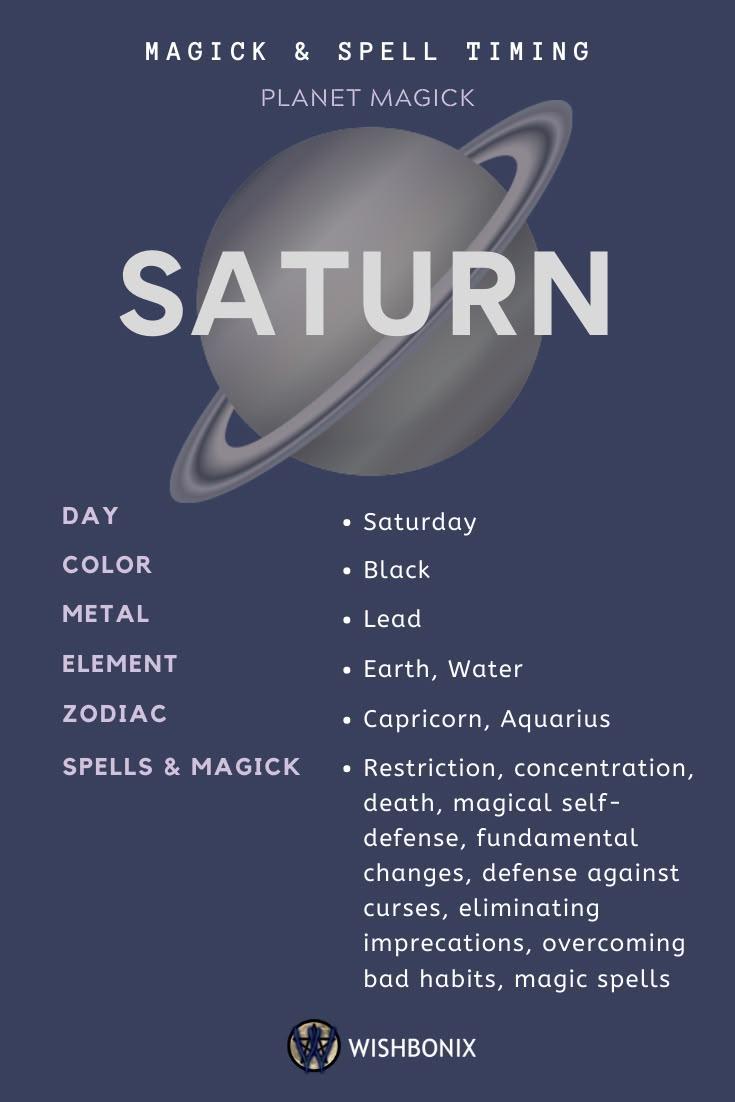
Saturn rules the zodiac signs Capricorn and Aquarius (in traditional astrology). It is associated with the bones, teeth, and skeletal structure of the body — the framework that holds everything together. In a natal chart, Saturn's placement reveals where a person will face their greatest challenges and, through perseverance, their greatest accomplishments.
Kronos and the Nature of Time
The mythological connection between Saturn and Kronos is deeply relevant to understanding Saturn hour meaning. Kronos was the Titan who devoured his own children — a grim metaphor for the way time consumes everything. Yet Kronos also presided over a legendary Golden Age of peace and abundance, suggesting that mastery over time leads to prosperity. This dual nature — destruction and creation, restriction and reward — is the essence of Saturn's energy during its planetary hours.
When you work during a Saturn hour, you are aligning yourself with this principle of structured creation through disciplined effort. You are acknowledging that meaningful accomplishments require time, patience, and the willingness to endure temporary discomfort for long-term gain. The Saturn hour is not about shortcuts; it is about doing the work that matters.
Saturn's Elemental and Symbolic Associations
Saturn is associated with the element of Earth and the quality of cold and dry. Its metal is lead — heavy, dense, and resistant to corrosion. Its colors are black, dark brown, and deep indigo. Its day is Saturday. In the system of planetary hours, Saturn's energy carries all of these associations: heaviness, gravity, seriousness, durability, and depth. Activities undertaken during Saturn hours benefit from this grounding, stabilizing influence.
Best Activities During Saturn Hour
The Saturn hour is optimally suited for activities that require sustained effort, serious focus, and a long-term perspective. Here is a detailed breakdown of the best Saturn hour activities, organized by category:
Long-Term Planning & Strategy
Saturn's energy excels at looking far ahead. The Saturn hour is ideal for:
- Writing five-year business plans and strategic roadmaps
- Setting long-term goals with concrete milestones and deadlines
- Reviewing and adjusting retirement plans or investment strategies
- Mapping out career trajectories and professional development paths
- Creating project timelines for complex, multi-phase undertakings
- Estate planning and legacy considerations
The key quality Saturn brings to planning is realism. Pie-in-the-sky thinking belongs to Jupiter. During a Saturn hour, your plans should be grounded, practical, and honest about the obstacles ahead. This is when you ask the hard questions: What could go wrong? What is the timeline actually? What resources do I really need?
Financial Organization
Saturn has a strong affinity with money management — not the speculative, wealth-building side (that belongs more to Jupiter and the Sun), but the structural, organizational side:
- Paying bills and settling outstanding debts
- Creating and reviewing budgets with realistic spending limits
- Organizing financial records, tax documents, and receipts
- Negotiating repayment plans or debt consolidation terms
- Reviewing insurance policies and coverage adequacy
- Closing old accounts and simplifying financial structures
Saturn rewards fiscal responsibility and punishes financial carelessness. If you have been avoiding your bank statements or putting off that conversation with your accountant, the Saturn hour provides the energetic backbone to face these tasks head-on.
Serious Study & Research
Saturn governs concentrated intellectual labor — the kind of study that builds genuine expertise rather than superficial familiarity:
- Studying for professional certifications or advanced degrees
- Reading dense academic or technical material that requires sustained attention
- Conducting systematic research with rigorous methodology
- Writing dissertations, theses, or technical reports
- Learning complex skills that require repetitive practice (instruments, languages, mathematics)
- Memorizing large bodies of information through disciplined review
The Saturn hour is particularly effective for subjects you find difficult or intimidating. Saturn's energy does not make hard things easy — it makes you capable of doing hard things. For practical guidance on scheduling study sessions around planetary hours, see our guide on how to use planetary hours.
Property & Real Estate
Saturn has a traditional rulership over land, buildings, foundations, and physical structures:
- Reviewing property contracts and lease agreements
- Planning construction projects or major renovations
- Inspecting properties for structural integrity
- Negotiating real estate transactions where patience is an advantage
- Filing property-related legal documents
- Dealing with landlords, tenants, or property managers on serious matters
The enduring, foundational quality of Saturn's energy makes it naturally suited to matters involving permanent structures and long-term property commitments.
Authority & Career Advancement
Saturn governs hierarchies, authority structures, and the patient climb to positions of responsibility:
- Meeting with supervisors, mentors, or authority figures
- Applying for promotions or positions of greater responsibility
- Writing performance reviews or self-assessments
- Establishing professional credibility through demonstrations of competence
- Networking with senior professionals and industry leaders
- Defining organizational structures, roles, and reporting lines
During Saturn hours, interactions with authority figures tend to be more productive when you approach them with preparation, respect for protocol, and a clear demonstration of your reliability. Saturn does not reward charm — it rewards track records.
Boundary Setting & Self-Discipline
Perhaps Saturn's most personal gift is the capacity for firm, healthy boundaries:
- Having difficult conversations about expectations and limits
- Ending relationships or commitments that no longer serve your growth
- Establishing new routines and disciplined habits
- Decluttering and organizing physical and digital spaces
- Making commitments you intend to keep — and defining consequences for breaking them
- Practicing self-denial or austerity as a spiritual or health discipline (fasting, digital detox, etc.)
The Saturn hour supports the inner resolve needed to say "no" — to others and to your own impulses. If you struggle with boundaries, intentionally scheduling difficult boundary conversations during Saturn hours can provide a subtle but real energetic advantage.
What to Avoid During Saturn Hour
Just as certain activities thrive under Saturn's influence, others are actively hindered by it. The Saturn hour is generally not the best time for:
- Launching new ventures or startups — Saturn's cautious energy can dampen the optimism and risk-tolerance needed for new beginnings. Wait for a Sun or Jupiter hour instead.
- Spontaneous social activities — Saturn prefers structure. Impromptu gatherings, casual hangouts, and unplanned adventures tend to feel flat or forced during Saturn hours.
- Parties and celebrations — The heavy, serious tone of Saturn is at odds with festivity. Venus and Sun hours are far better for joyful social events.
- Creative brainstorming — Free-flowing, expansive creativity needs the openness of Jupiter or the inspiration of Venus. Saturn's energy tends to constrain imaginative thinking.
- Asking for favors — Saturn is the planet of earning through effort, not receiving through generosity. Requests for help or leniency may meet resistance.
- Starting romantic relationships — The cold, serious energy of Saturn does not support the warmth and spontaneity that new romance requires. Venus hours are the obvious alternative.
- Gambling or speculative investments — Saturn punishes recklessness with money. High-risk financial moves are best avoided during Saturn's rulership.
- Elective medical procedures — Traditional astrologers advise caution with Saturn hours for surgery or medical treatments, as Saturn's association with restriction and delay can complicate recovery.
The general principle is straightforward: if an activity requires warmth, spontaneity, expansion, optimism, or speed, it probably does not belong in a Saturn hour. Save those things for planetary hours ruled by the Sun, Venus, Jupiter, or Mercury.
Saturn Hour on Saturday: The Taskmaster's Domain
Saturday — the very name derived from "Saturn's day" — holds special significance in the planetary hours system. On Saturday, the first planetary hour after sunrise is ruled by Saturn, making it the Day Ruler. This means the entire day carries a stronger Saturn imprint than any other day of the week.
Why Saturn Hours on Saturday Are Extra Powerful
When a planet rules both the day and the hour, its influence is doubled. The first Saturn hour on Saturday morning is considered the most potent Saturn hour of the entire week. If you have a particularly important Saturn-aligned task — signing a major contract, having a critical career conversation, or finalizing a long-term financial plan — Saturday's first hour is the optimal window.
The subsequent Saturn hours throughout Saturday also carry this amplified quality, though to a lesser degree. Many practitioners of planetary hours astrology reserve Saturday specifically for Saturn-type work: cleaning, organizing, paying bills, studying, and tackling deferred responsibilities.
Saturday Rituals and Traditions
Across cultures and centuries, Saturday has been associated with discipline and reflection. In Jewish tradition, the Sabbath (Shabbat) begins Friday evening, making Saturday a day of rest and contemplation — qualities aligned with Saturn's reflective energy. In Hindu astrology, Saturday (Shanivar) is the day of Shani, the planet Saturn, and is considered auspicious for worship, penance, and acts of discipline. Even in secular modern culture, Saturday is often the day people catch up on household chores, organize their lives, and prepare for the week ahead — all Saturn-appropriate activities.
Understanding the relationship between Saturn hours on Saturday and these broader cultural patterns reveals how deeply embedded Saturn's archetypal energy is in human consciousness. For a comprehensive understanding of how planetary days interact with planetary hours, consult our Planetary Hours FAQ.
How to Work With Saturn's Restrictive Energy
Saturn's energy can feel heavy, even oppressive, if you resist it. The key to working productively with Saturn hours is not to fight the restriction but to use it. Here are strategies for transmuting Saturn's heaviness into productive power:
Embrace Structure as Freedom
This is Saturn's core paradox: limitation creates freedom. A writer facing a blank page has infinite possibilities and often infinite paralysis. Give that writer a strict word count, a deadline, and a specific topic, and suddenly the words flow. Saturn hours work the same way. Instead of resisting the sense of constriction, use it. Set tight parameters for your work. Define exactly what you will accomplish during the Saturn hour, and let the narrowed focus sharpen your output.
Front-Load the Hardest Tasks
Saturn hours are the wrong time for easy, pleasant work. They are the right time for the tasks you have been procrastinating on — the tax filing, the difficult email, the challenging study material, the overdue maintenance. Saturn's energy provides the sober determination to push through resistance. Use it for what it is best at: getting hard things done.
Practice Patience
Saturn is the slowest-moving of the classical planets, taking approximately 29.5 years to orbit the Sun. Its hours reward patience, not urgency. If a task is not completed during one Saturn hour, do not panic. Pick it up at the next Saturn hour. Saturn teaches that meaningful work unfolds over time, not in a single burst of effort.
Respect the Energy, Do Not Force Misaligned Activities
If you find yourself trying to be creative, social, or spontaneous during a Saturn hour and it feels like pushing a boulder uphill — stop. You are working against the current. Shift to a Saturn-appropriate task, and save the lighter activities for a more compatible planetary hour. Working with planetary hours is about alignment, not brute force.
Use Physical Grounding Techniques
Saturn is an Earth-associated planet. During Saturn hours, physical grounding can help you channel the energy effectively:
- Work at a clean, organized desk
- Wear dark, structured clothing
- Drink black coffee or strong tea (no frills)
- Sit in a firm chair with good posture
- Keep your workspace cool rather than warm
These small adjustments align your physical environment with Saturn's energetic signature, creating a coherent field that supports focused work.
Finding Your Saturn Hour Today
Locating your Saturn hour today is straightforward with the right tool. Because planetary hours depend on your precise geographic coordinates and the exact sunrise and sunset times for your location on a given date, manual calculation is impractical for daily use.
Our Planetary Hours Calculator does the work instantly. Simply enter your city or coordinates and the date, and the calculator displays every planetary hour for that 24-hour period, including all Saturn hours, with their exact start and end times. The current planetary hour is highlighted in real time, so you always know which planetary energy is active right now.
For those who want to understand the mathematics behind the calculation — how sunrise and sunset times determine hour lengths, and how the Chaldean sequence assigns planetary rulers — our article on the algorithm behind the calculator provides a full technical explanation.
Quick Reference: Saturn Hour Timing Patterns
While exact times vary by location and date, Saturn hours follow a predictable pattern based on the day of the week:
- Saturday: Saturn rules the 1st, 8th, and 15th (3rd nighttime) hours — the most Saturn-heavy day
- Sunday: Saturn rules the 2nd, 9th, and 16th hours
- Monday: Saturn rules the 3rd, 10th, and 17th hours
- Tuesday: Saturn rules the 4th, 11th, and 18th hours
- Wednesday: Saturn rules the 5th, 12th, and 19th hours
- Thursday: Saturn rules the 6th, 13th, and 20th hours
- Friday: Saturn rules the 7th, 14th, and 21st hours
This pattern means that on most days, you will have at least three opportunities to work within a Saturn hour. On Saturday, the alignment of day ruler and hour ruler creates the strongest Saturn windows of the week.
Practical Tips for Saturn Hour Success
To make the most of Saturn hour activities, integrate these practical habits into your routine:
-
Plan your Saturn work in advance. Do not enter a Saturn hour wondering what to do. Have your task list prepared — ideally written down on paper, which Saturn's earthy energy appreciates more than digital lists.
-
Start on time. Saturn respects punctuality and protocol. Begin your task at the exact start of the Saturn hour for maximum alignment.
-
Eliminate distractions completely. Turn off your phone, close unnecessary browser tabs, and inform others that you are unavailable. Saturn hours are not for multitasking.
-
Track your progress over weeks. Saturn rewards consistency over time. Keep a journal of what you accomplish during Saturn hours across multiple weeks. You will likely notice a pattern of steady, compounding progress.
-
Pair Saturn hours with Saturn days when possible. For maximum effect, schedule your most important Saturn-type work during a Saturn hour on Saturday. The doubled planetary influence creates the strongest possible energetic support.
-
Accept imperfection in the process. Saturn's standards are high, and its energy can trigger perfectionism. Remember that consistent effort matters more than flawless execution. Done is better than perfect — especially when Saturn's slow, steady energy is building something over months and years.
-
End with gratitude. After completing work during a Saturn hour, acknowledge what you accomplished. Saturn's energy can feel thankless, but recognizing your own discipline reinforces the positive feedback loop that keeps you returning to hard tasks.
-
Use the calculator regularly. Bookmark our Planetary Hours Calculator and check it daily. Over time, working with Saturn hours — and all planetary hours — becomes second nature, a rhythm that structures your week as naturally as the rising and setting of the Sun.
Explore All Planetary Hour Guides
Each planetary hour carries its own distinct energy. Explore our complete series to master every planetary hour:
- ☉ Sun Hour Guide: Leadership, Vitality & Success
- ☽ Moon Hour Guide: Intuition, Emotions & Lunar Timing
- ☿ Mercury Hour Guide: Communication, Learning & Mental Clarity
- ♀ Venus Hour Guide: Love, Beauty & Perfect Timing
- ♂ Mars Hour Guide: Energy, Courage & Action
- ♃ Jupiter Hour Guide: Growth, Abundance & Opportunity
Ready to find your next planetary hour? Use our free Planetary Hours Calculator to see all 24 hours for your location today.
Saturn's hours are not the flashiest or the most exciting in the planetary hours cycle. They will not fill you with the inspired enthusiasm of a Sun hour or the creative warmth of a Venus hour. But they will give you something more valuable: the quiet, unyielding power to build things that last. In a world obsessed with speed and novelty, Saturn's ancient wisdom — that true achievement requires time, structure, and unwavering discipline — is more relevant than ever.
Work with Saturn, not against it, and watch your most ambitious long-term goals begin to take solid, tangible form.
Frequently Asked Questions
What is the hour of Saturn good for?
The hour of Saturn is good for activities requiring discipline, responsibility, structure, and long-term planning. It favors paying bills, organizing finances, serious study, research, strategic planning, dealing with authority figures, setting boundaries, and tackling challenging tasks that require patience and perseverance.
What is Saturn time?
Saturn time refers to the planetary hours ruled by Saturn in the ancient Chaldean timing system. Unlike fixed 60-minute hours, Saturn hours vary in length depending on your location and the time of year. Saturn rules approximately 3-4 hours each day (scattered throughout the 24-hour cycle), with each Saturn hour lasting roughly 45-75 minutes depending on the season.
What activities are best during Saturn hour?
The best activities during Saturn hour include long-term financial planning, organizing and decluttering, studying difficult subjects, writing business plans, dealing with legal obligations, property matters, construction projects, ancestor work, meditation on discipline, and any task requiring focused concentration and perseverance.
Related Articles
Planetary Hours and Their Meanings: Complete Reference Guide
A comprehensive guide to all seven planetary hours and their meanings. Learn what each planetary hour represents, its ruling planet's energy, and the best activities for every hour.
Read more →Planetary Hours for Love & Relationships: Complete Timing Guide
Discover the best planetary hours for love, romance, and relationships. Learn why Venus hour is ideal for dates, Moon hour for emotional bonds, and how to time your romantic activities.
Read more →Planetary Hours and Days for Magic: A Practitioner's Guide
Learn how to align your magical workings with planetary hours and days for enhanced efficacy. A comprehensive guide to planetary correspondences, spell timing, and ritual planning.
Read more →