Planetary Hours and Their Meanings: Complete Reference Guide
Planetary Hours and Their Meanings: Complete Reference Guide
What do planetary hours mean? At the heart of this ancient timekeeping system lies a beautifully simple idea: every segment of the day carries a distinct energetic signature determined by its ruling planet. The seven classical planets — Sun, Moon, Mercury, Venus, Mars, Jupiter, and Saturn — cycle through the hours in a fixed sequence, infusing each period with qualities that can support or hinder specific activities. Understanding planetary hours and their meanings gives you a practical framework for aligning your actions with cosmic rhythms, whether you are scheduling a business meeting, planning a romantic evening, or choosing the right moment for deep study.
Unlike the uniform 60-minute blocks on a modern clock, planetary hours are dynamic. They divide the time between sunrise and sunset into 12 equal daytime hours, and the time between sunset and the next sunrise into 12 equal nighttime hours. Because daylight shifts with the seasons and your latitude, each planetary hour expands or contracts accordingly — a design that honors the natural pulse of the Earth rather than an arbitrary mechanical standard.
This guide serves as your central reference for all seven planetary hours and their meanings. Each section below explores one planet's hour in depth, covering its core symbolism, best activities, cautions, and links to our dedicated in-depth guides.
The Chaldean Order Explained
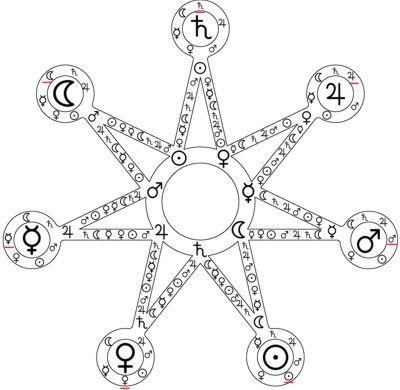
The sequence in which planets rule successive hours is called the Chaldean Order, named after the Babylonian astronomers who first codified the system over 2,500 years ago. The order is based on each planet's apparent orbital speed as observed from Earth, from slowest to fastest:
Saturn → Jupiter → Mars → Sun → Venus → Mercury → Moon
After the Moon (the fastest), the cycle returns to Saturn and repeats. This unbroken sequence threads through all 24 hours of every day, creating a seamless tapestry of shifting planetary energies.
How the Chaldean Order Determines the Day Ruler
An elegant consequence of the Chaldean Order is that it also explains why each day of the week is named after a particular planet. The first planetary hour after sunrise is always ruled by the Day Ruler — the planet that gives the day its name:
- Sunday → Sun rules the first hour
- Monday → Moon rules the first hour
- Tuesday → Mars rules the first hour
- Wednesday → Mercury rules the first hour
- Thursday → Jupiter rules the first hour
- Friday → Venus rules the first hour
- Saturday → Saturn rules the first hour
From that starting point, each subsequent hour follows the Chaldean Order. By the time 24 hours have passed, the mathematics of the seven-planet cycle naturally land on the correct ruler for the next day — a self-sustaining system that has operated without adjustment for millennia.
The Seven Planetary Hours at a Glance
Before diving into the details, here is a quick-reference summary of each planetary hour and its core meaning:
| Planet | Symbol | Core Theme | Best For | Avoid | |--------|--------|------------|----------|-------| | Sun | ☉ | Leadership & Vitality | Public appearances, promotions, creative launches | Secrecy, behind-the-scenes work | | Moon | ☽ | Emotion & Intuition | Family time, meditation, emotional healing | Cold rationality, high-risk speculation | | Mercury | ☿ | Communication & Intellect | Writing, negotiations, study, travel | Emotional confrontations, monotonous labor | | Venus | ♀ | Love & Beauty | Dates, socializing, art, beauty treatments | Conflict, harsh criticism | | Mars | ♂ | Action & Courage | Physical exercise, decisive action, competition | Diplomacy, delicate negotiations | | Jupiter | ♃ | Expansion & Abundance | Financial planning, business expansion, learning | Overlooking details, extravagance | | Saturn | ♄ | Discipline & Structure | Long-term projects, audits, boundary setting | Spontaneous socializing, quick wins |
Now let's explore each planetary hour in full depth.
☉ Sun Hour Meaning
The Sun hour is the most radiant period in the planetary cycle — a window of time saturated with confidence, authority, and creative fire. When the Sun rules the hour, the cosmic spotlight is on, making it the ideal moment for anything that benefits from visibility and personal power.
Core Symbolism
The Sun represents the core self, vitality, willpower, and the drive toward achievement. In every astrological tradition worldwide, it occupies a central position as the source of light, life, and consciousness. During a Sun hour, these qualities are amplified in the surrounding atmosphere, creating favorable conditions for bold action.
Best Activities During Sun Hour
- Leadership and authority: Present proposals to executives, chair important meetings, pitch to investors, or request a promotion. The Sun hour lends gravitas and persuasive power to your words.
- Public appearances: Deliver speeches, perform on stage, attend interviews, or record content for social media. Visibility-focused tasks thrive under solar energy.
- Creative launches: Unveil new projects, publish creative work, or debut a product. The Sun's energy draws attention and recognition.
- Health and vitality: Engage in vigorous exercise, outdoor activities, or any practice designed to boost physical energy and confidence.
Cautions
Sun hours are poorly suited for tasks that require stealth, discretion, or deep solitude. The energy is outward-facing and performative; working behind the scenes or engaging in quiet contemplation may feel forced during this period.
Peak Power
Sun hour reaches its maximum potency on Sunday, when the Day Ruler and the Hour Ruler align in a double-Sun configuration. For the complete deep dive, see our Sun Hour Guide.
☽ Moon Hour Meaning
The Moon hour introduces a softer, more introspective quality to the day. Where the Sun pushes outward, the Moon draws inward — inviting emotional awareness, intuition, and nurturing connection.
Core Symbolism
The Moon governs the emotional body, the subconscious mind, memory, fertility, and the cyclical rhythms of nature. It is intimately tied to home, family, and the collective feeling of a community. In a Moon hour, the veil between conscious thought and deeper intuition thins, making it easier to access inner wisdom.
Best Activities During Moon Hour
- Emotional connection: Have heartfelt conversations with loved ones, reconnect with family, or address unresolved feelings in a relationship. The Moon hour supports vulnerability and empathy.
- Introspection and healing: Meditate, journal, practice breathwork, or attend a therapy session. Subconscious patterns surface more readily under lunar influence.
- Domestic life: Cook a nourishing meal, reorganize your living space, tend a garden, or plan family events. The Moon hour favors homemaking and caregiving.
- Public engagement: Publish content designed to evoke emotion, conduct audience research, or launch community outreach campaigns. The Moon governs collective sentiment.
Cautions
Avoid making major decisions that demand cold, detached logic during a Moon hour — emotions may cloud judgment. High-risk speculative ventures and aggressive confrontations are also misaligned with lunar energy.
Peak Power
Moon hour is strongest on Monday, the Moon's own day. For the complete deep dive, see our Moon Hour Guide.
☿ Mercury Hour Meaning
Mercury hour electrifies the mind. It is the premier window for intellectual work, clear communication, and swift information exchange — the cosmic equivalent of a perfectly brewed cup of coffee for your brain.
Core Symbolism
Mercury rules communication, language, logic, commerce, short journeys, and the processing of information. Named after the fleet-footed messenger of the gods, Mercury energy is fast, adaptable, and analytically sharp. During a Mercury hour, the mental faculties operate at peak efficiency.
Best Activities During Mercury Hour
- Writing and study: Draft reports, compose emails, write articles, prepare for exams, or absorb new material. Mercury sharpens clarity of thought and expression.
- Negotiations and contracts: Sign agreements, negotiate deals, or make sales calls. The mercurial atmosphere favors articulate persuasion and the exchange of favorable terms.
- Technology and data: Debug code, analyze data, configure systems, or brainstorm solutions to technical problems. Mercury thrives on intellectual puzzles.
- Short travel and errands: Plan or embark on local trips, run errands, or handle logistics. Mercury governs all forms of movement and coordination.
Cautions
Mercury hour is less ideal for conversations that require deep emotional engagement without a logical framework. It can also lead to overthinking or hasty decisions if you rush the analytical process. Monotonous physical labor gains little from Mercury's mental energy.
Peak Power
Mercury hour reaches its zenith on Wednesday (literally "Woden's day," the Norse parallel to Mercury). For the complete deep dive, see our Mercury Hour Guide.
♀ Venus Hour Meaning
Venus hour wraps the world in warmth, beauty, and the desire for connection. It is the most harmonious period in the planetary cycle — an invitation to soften, enjoy, and attract.
Core Symbolism
Venus embodies love, beauty, art, pleasure, social grace, cooperation, and material comfort. She is the planet of attraction in every sense: romantic attraction, aesthetic attraction, and the magnetic pull that draws resources and allies toward you. During a Venus hour, relationships flow more smoothly and creative sensibilities heighten.
Best Activities During Venus Hour
- Romance and relationships: Go on a date, propose, express love, or have a reconciliation conversation. Venus hour infuses interactions with tenderness and charm.
- Art and aesthetics: Visit a gallery, attend a concert, practice painting or music, redecorate a room, or get a beauty treatment. Venus governs all things beautiful.
- Socializing and cooperation: Host gatherings, network, build alliances, or negotiate partnerships. Venus favors win-win outcomes and pleasant atmospheres.
- Self-care and pleasure: Enjoy a luxurious meal, take a spa day, or simply spend time doing something that brings you joy. Venus celebrates sensory delight.
Cautions
Venus hour is not the time for confrontation, harsh criticism, or competitive battles. The energy resists aggression and rewards diplomacy. Be mindful of overspending or over-indulging, as Venus can tip toward excess when unchecked.
Peak Power
Venus hour is most powerful on Friday, her traditional day. For the complete deep dive, see our Venus Hour Guide.
♂ Mars Hour Meaning
Mars hour is the planetary cycle's shot of adrenaline — raw, focused, and primed for action. When Mars rules the hour, hesitation fades and the impulse to move, build, and conquer takes center stage.
Core Symbolism
Mars represents action, courage, willpower, competition, physical energy, and the drive to overcome obstacles. Named after the Roman god of war, Mars energy is direct, assertive, and unapologetically forceful. In a Mars hour, the atmosphere crackles with kinetic potential, making it the ideal moment to channel intensity toward productive ends.
Best Activities During Mars Hour
- Physical exercise: Hit the gym, run, lift weights, or engage in competitive sports. Mars fuels the body with peak physical energy.
- Decisive action: Launch a bold initiative, break through a creative block, tackle your most intimidating task, or make a fast decision on a time-sensitive matter.
- Competitive pursuits: Compete in any arena — business pitches, athletic events, auctions, or strategic games. Mars rewards those who act with conviction.
- Overcoming obstacles: Confront problems head-on, have a difficult but necessary conversation, or push through resistance on a stalled project.
Cautions
Mars hour is a poor choice for activities requiring patience, tact, or gentle diplomacy. Avoid delicate negotiations, emotional heart-to-hearts, and situations where temper flare-ups could cause lasting damage. Channel the warrior energy constructively to avoid unnecessary conflict.
Peak Power
Mars hour is strongest on Tuesday, the day of Mars (from the Latin "dies Martis"). For the complete deep dive, see our Mars Hour Guide.
♃ Jupiter Hour Meaning
Jupiter hour opens the doors of opportunity, expansion, and good fortune. It is the most auspicious period for growth-oriented activity — a cosmic green light for abundance in all its forms.
Core Symbolism
Jupiter is the Greater Benefic in traditional astrology, representing expansion, prosperity, wisdom, higher learning, generosity, and long-range vision. Where other planets focus energy narrowly, Jupiter broadens horizons and multiplies possibilities. During a Jupiter hour, optimism rises naturally and conditions become favorable for attracting resources, mentors, and favorable outcomes.
Best Activities During Jupiter Hour
- Financial planning: Make investment decisions, explore new revenue streams, negotiate raises, or submit loan applications. Jupiter is the planet of material abundance.
- Business expansion: Launch new product lines, enter new markets, sign major contracts, or formalize partnerships. Jupiter supports bold, growth-oriented moves.
- Learning and wisdom: Begin a course of study, attend lectures, read philosophy or law, or consult with mentors and advisors. Jupiter governs higher knowledge.
- Philanthropy and generosity: Make charitable donations, volunteer, or perform acts of generosity. Jupiter's expansive nature rewards giving.
Cautions
Jupiter's optimism can tip into overconfidence. Guard against overlooking critical details, over-committing resources, or making extravagant promises you cannot keep. Tasks requiring tight economizing or contraction are mismatched with Jupiter's expansive pull.
Peak Power
Jupiter hour is most potent on Thursday, traditionally Jupiter's day (from the Norse "Thor's day"). For the complete deep dive, see our Jupiter Hour Guide.
♄ Saturn Hour Meaning
Saturn hour is the planetary cycle's anchor — sober, focused, and built for endurance. Where Jupiter expands, Saturn contracts, encouraging discipline, structure, and the patient accumulation of lasting results.
Core Symbolism
Saturn represents discipline, responsibility, boundaries, time, tradition, and the wisdom that comes from sustained effort. Often called the "Great Teacher" or "Lord of Karma," Saturn rewards those who approach its hours with seriousness and a willingness to do the hard work that others avoid. During a Saturn hour, distractions naturally recede and deep concentration becomes more accessible.
Best Activities During Saturn Hour
- Long-term projects: Work on complex tasks requiring sustained focus — writing a thesis, drafting a strategic plan, completing a detailed audit, or building something that must last.
- Organization and structure: Declutter your workspace, create filing systems, establish routines, or set clear boundaries in professional or personal relationships.
- Legal and official matters: Handle contracts, legal filings, tax preparation, or dealings with authorities. Saturn governs formal structures and institutions.
- Reflection and closure: End relationships or commitments that no longer serve you, learn from past mistakes, or conduct a personal review of your goals and progress.
Cautions
Saturn hour is inhospitable to spontaneity, lighthearted socializing, and speculative ventures that need quick results. New launches and celebrations feel heavy under Saturn's weight. Save those for a Sun or Jupiter hour instead.
Peak Power
Saturn hour is most powerful on Saturday, Saturn's own day. For the complete deep dive, see our Saturn Hour Guide.
How Planetary Hours Are Calculated
The calculation of planetary hours follows a precise astronomical process rooted in real-time solar data:
- Determine sunrise and sunset for your exact geographic coordinates using astronomical algorithms (our calculator uses the respected SunCalc.js library).
- Divide the daylight period (sunrise to sunset) into 12 equal segments — these are your 12 daytime planetary hours.
- Divide the nighttime period (sunset to next sunrise) into 12 equal segments — these are your 12 nighttime planetary hours.
- Assign rulers starting with the Day Ruler (the planet that gives the weekday its name) for the first hour at sunrise, then follow the Chaldean Order (Saturn → Jupiter → Mars → Sun → Venus → Mercury → Moon) for each subsequent hour.
- Apply time zone corrections to convert UTC results into your local wall-clock time, including Daylight Saving Time adjustments.
Because this process depends on your exact location and date, no two days produce identical planetary hour schedules — and a planetary hour at the equator will differ in length from one at a northern latitude during the same season. For a technical deep dive into the algorithm, including how we handle edge cases and achieve second-level accuracy, read The Algorithm Behind Our Calculator.
Using Planetary Hours in Daily Life
Integrating planetary hours into your routine does not require rigid adherence or advanced astrological knowledge. The core principle is simple: match the nature of your activity to the energy of the current planetary hour. Need to write an important email? Wait for a Mercury hour. Planning a date night? A Venus hour sets the perfect atmosphere.
Here are practical strategies to get started:
- Morning awareness: Check which planet rules the first hour after sunrise — this is the Day Ruler, and its energy often sets the tone for the entire day.
- Weekly planning: At the start of each week, identify key activities and note which planetary hours would best support them. Use our calculator to find the exact times.
- Journaling: Keep a simple log of what you did during different planetary hours and how it went. Over time, you'll discover personal patterns and resonances.
- Flexibility over dogma: Planetary hours are a guide, not a commandment. When circumstances don't allow perfect alignment, understanding the current energy still helps you adjust your approach.
For a comprehensive guide to applying planetary hours across career, relationships, health, and finance, read our Practical Guide to Using Planetary Hours.
Find Your Current Planetary Hour
Ready to put this knowledge into practice? Our Planetary Hours Calculator instantly shows you the current planetary hour for your exact location, along with curated activity suggestions for each hour. Simply enter your location or allow GPS detection, and you'll see a complete schedule from sunrise through the night — including the ruling planet, start and end times, and "Good For" and "Avoid" recommendations.
Whether you are new to planetary hours or a seasoned practitioner, precise timing transforms abstract knowledge into actionable daily guidance. Start exploring your planetary hours today.
Frequently Asked Questions
What do planetary hours mean?
Planetary hours are segments of time ruled by the seven classical planets (Sun, Moon, Mercury, Venus, Mars, Jupiter, Saturn), each carrying distinct energetic qualities. The meaning of each planetary hour reflects its ruling planet: Sun hours favor leadership and success, Moon hours govern emotions and intuition, Mercury hours enhance communication, Venus hours promote love and beauty, Mars hours energize action and courage, Jupiter hours attract abundance and growth, and Saturn hours support discipline and long-term planning.
How many planetary hours are there in a day?
There are 24 planetary hours in each day — 12 daytime hours (from sunrise to sunset) and 12 nighttime hours (from sunset to the next sunrise). Unlike clock hours, planetary hours are not fixed at 60 minutes. Their length varies based on your location and the time of year, because daylight and nighttime durations change with the seasons.
What is the Chaldean order of planets?
The Chaldean order is Saturn, Jupiter, Mars, Sun, Venus, Mercury, Moon — arranged by their apparent orbital speed as observed from Earth. This sequence determines which planet rules each successive planetary hour. The cycle repeats continuously throughout the day and night.
Related Articles
Planetary Hours for Love & Relationships: Complete Timing Guide
Discover the best planetary hours for love, romance, and relationships. Learn why Venus hour is ideal for dates, Moon hour for emotional bonds, and how to time your romantic activities.
Read more →Planetary Hours and Days for Magic: A Practitioner's Guide
Learn how to align your magical workings with planetary hours and days for enhanced efficacy. A comprehensive guide to planetary correspondences, spell timing, and ritual planning.
Read more →Planetary Hours for Manifestation: Align Your Intentions with Cosmic Timing
Learn how to use planetary hours for manifestation and intention-setting. Discover which planetary hours amplify abundance, love, career success, and spiritual growth.
Read more →