Planetary Days of the Week: Complete Guide to Daily Planetary Rulers
Planetary Days of the Week: Complete Guide to Daily Planetary Rulers
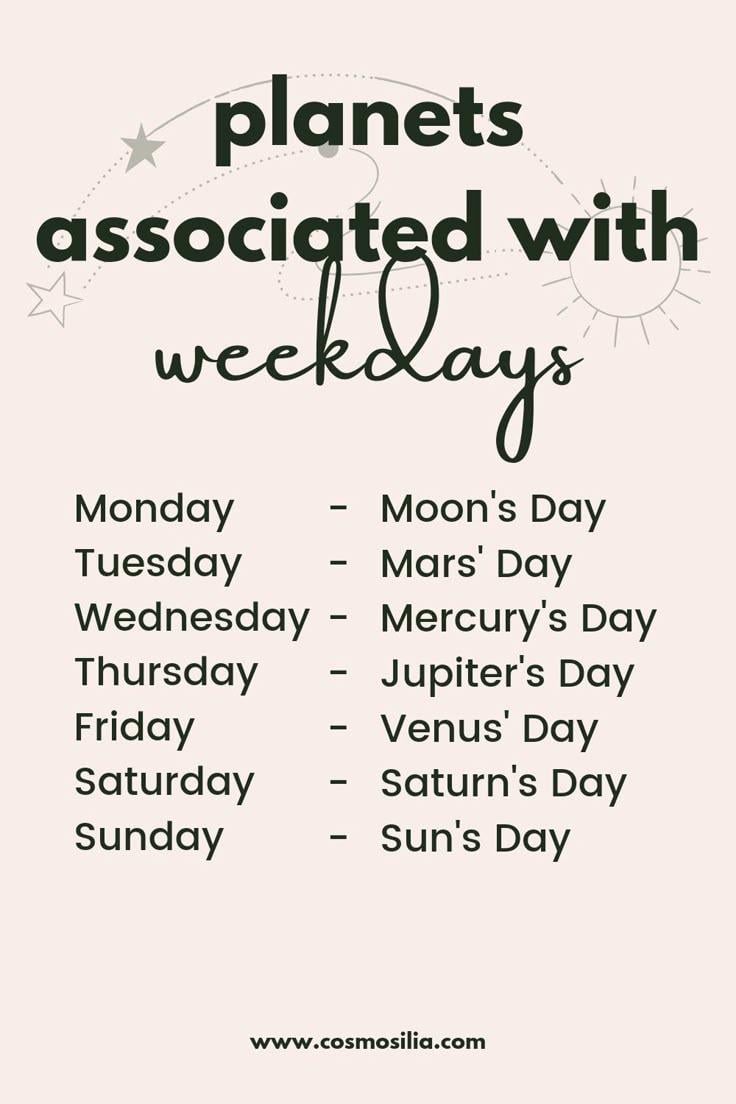
What planet rules each day of the week? The answer is one of the oldest and most enduring principles in astrology: Sunday is ruled by the Sun, Monday by the Moon, Tuesday by Mars, Wednesday by Mercury, Thursday by Jupiter, Friday by Venus, and Saturday by Saturn. This seven-planet, seven-day system has shaped calendars, languages, and spiritual practices across civilizations for over two thousand years. Far from being a relic of the past, the planetary days of the week remain a practical and powerful framework for aligning your daily activities with the natural rhythms of celestial energy.
Whether you are new to astrology or a seasoned practitioner, understanding the planetary days gives you an immediate tool for better timing. Each day carries a distinct energetic signature — the character, strengths, and tendencies of its ruling planet — that subtly influences everything from your mood and motivation to the success of your endeavors. By learning which planet rules each day and what that planet represents, you can begin to schedule important activities, set meaningful intentions, and work with the cosmic current rather than against it.
This guide covers all seven planetary days in depth, traces the linguistic and historical origins of their names, explains how planetary days connect to planetary hours, and offers practical advice for using this ancient system in your modern life. Use our Planetary Hours Calculator to find the exact planetary hours for any date and location.
The Seven Planetary Days
The table below provides a complete overview of the seven planetary days, their ruling planets, associated symbols, core energy themes, and the activities each day best supports.
| Day | Ruling Planet | Symbol | Energy Theme | Best Activities | |---|---|---|---|---| | Sunday | Sun ☉ | Gold, Lion | Leadership, vitality, self-expression | Creative projects, goal-setting, public appearances, self-care | | Monday | Moon ☽ | Silver, Crab | Emotion, intuition, nurturing | Family matters, journaling, domestic tasks, emotional healing | | Tuesday | Mars ♂ | Red, Ram | Action, courage, competition | Physical exercise, bold decisions, surgery, confronting challenges | | Wednesday | Mercury ☿ | Orange, Twins | Communication, intellect, commerce | Writing, studying, negotiations, technology work, short travel | | Thursday | Jupiter ♃ | Blue, Archer | Expansion, wisdom, abundance | Financial decisions, legal matters, education, publishing, travel | | Friday | Venus ♀ | Green, Bull/Scales | Love, beauty, harmony | Romantic dates, art, social events, beauty treatments, reconciliation | | Saturday | Saturn ♄ | Black, Goat | Discipline, structure, patience | Long-term planning, organization, boundary-setting, deep study |
This sequence is not arbitrary. It derives from the ancient Chaldean Order of planets, arranged by their apparent speed from slowest (Saturn) to fastest (Moon), cycling through a 24-hour period of planetary hours. The planet that rules the first hour after sunrise on a given day becomes that day's ruler — and the mathematical progression through seven planets over seven days produces exactly the weekday order we still use today.
Origins of Planetary Day Names
One of the most compelling proofs of the planetary day system's deep roots is the fact that the names of the days of the week, in dozens of languages, directly reference the seven classical planets. The connections are not hidden — they are embedded in the very words we speak every day.
Sunday comes from the Old English Sunnandæg, meaning "Sun's day," a direct translation of the Latin dies Solis. The solar connection is preserved across many language families: in Japanese, Sunday is Nichiyōbi (日曜日, "Sun day"); in Hindi, it is Ravivār (from Ravi, the Sun).
Monday derives from Old English Mōnandæg, "Moon's day," translating Latin dies Lunae. French preserves the Latin root in Lundi, Spanish in Lunes, and Japanese in Getsuyōbi (月曜日, "Moon day").
Tuesday takes its name from Tīwesdæg, the day of Tīw (or Tyr), the Norse god of single combat and justice. Tyr was the Germanic equivalent of Mars, the Roman god of war. The Martian origin is unmistakable in Romance languages: Martes (Spanish), Mardi (French), Martedì (Italian).
Wednesday comes from Wōdnesdæg, the day of Woden (Odin), the Norse god of wisdom, communication, and knowledge. Woden was identified with Mercury, the Roman messenger god. Romance languages make the Mercury connection explicit: Miércoles (Spanish), Mercredi (French), Mercoledì (Italian).
Thursday derives from Þūnresdæg, the day of Þunor (Thor), the thunder god. Thor was the Germanic counterpart of Jupiter, the Roman king of the gods. The Jovian root is clear in Jueves (Spanish), Jeudi (French), and Giovedì (Italian).
Friday comes from Frīgedæg, the day of Frige (Freya), the Norse goddess of love and beauty, identified with Venus. The Venusian connection appears directly in Viernes (Spanish), Vendredi (French), and Venerdì (Italian).
Saturday is unique among English day names in preserving the original Roman planetary god directly: Sæternesdæg, from Latin dies Saturni, "day of Saturn." While other Germanic languages replaced Roman gods with Norse equivalents, Saturn kept his name — a testament to his formidable cultural authority.
This remarkable cross-cultural consistency demonstrates that the planetary day system was not the invention of any single civilization. It represents a shared understanding, transmitted across the Roman Empire and beyond, that the seven visible celestial bodies define the character of each day.
Sunday — Day of the Sun
Sunday opens the traditional week under the brilliant rulership of the Sun, the central luminary of our solar system and the archetypal symbol of consciousness, vitality, and creative power. In astrological tradition, the Sun represents the core self — your identity, willpower, authority, and capacity to shine.
On Sundays, the solar energy favors activities that put you at the center: leadership initiatives, creative performances, goal-setting sessions, public appearances, and practices that nourish your physical vitality. The Sun's warmth also supports self-care rituals, from outdoor exercise to meditation focused on personal empowerment.
Sunday is the ideal day for setting the tone and vision for the week ahead. Rather than treating it purely as a rest day, consider it a day for intention and illumination — a time to clarify what matters most and commit your energy accordingly.
For a detailed exploration of Sun energy and timing, read the Sun Hour Guide and the Sunday deep dive.
Monday — Day of the Moon
Monday belongs to the Moon, the celestial body closest to Earth and the ruler of emotions, intuition, memory, dreams, and all matters related to home, family, and nurturing. While modern culture often frames Monday as a dreaded start to the work grind, its lunar rulership suggests a gentler approach: Monday is best suited for receptive, reflective, and emotionally attuned activities.
The Moon's energy on Monday supports journaling, emotional check-ins, family conversations, domestic organization, and any task that benefits from heightened sensitivity. It is an excellent day for setting intentions for the week from an emotional rather than purely strategic perspective — asking not just "What do I want to accomplish?" but "How do I want to feel?"
Monday's lunar influence also makes it a potent day for intuitive work: divination, dream analysis, creative brainstorming that draws on the subconscious, and therapeutic conversations. Avoid scheduling sharp confrontations or high-pressure negotiations on Monday if possible — the Moon's energy is receptive and nurturing, not combative.
For a detailed exploration of Moon energy and timing, read the Moon Hour Guide and the Monday deep dive.
Tuesday — Day of Mars
Tuesday is governed by Mars, the red planet of war, action, physical energy, courage, and decisive force. Of all seven days, Tuesday carries the most dynamic and assertive energy. It is the day to tackle challenges head-on, engage in physical competition, make bold decisions, and push through obstacles that have been holding you back.
Mars energy is direct, forceful, and uncompromising. Tuesday favors activities that require initiative and courage: launching competitive initiatives, beginning intense exercise programs, undergoing surgical procedures, filing legal actions, and confronting situations you have been avoiding. The martial energy cuts through hesitation and rewards those who act decisively.
The shadow side of Mars is aggression without purpose. Channel Tuesday's energy into constructive action rather than impulsive anger. Physical exercise is one of the best outlets for Martian energy — a hard workout on Tuesday can transform restless aggression into productive vitality.
For a detailed exploration of Mars energy and timing, read the Mars Hour Guide and the Tuesday deep dive.
Wednesday — Day of Mercury
Wednesday falls under the swift dominion of Mercury, the messenger planet governing communication, intellect, commerce, writing, teaching, technology, and all forms of information exchange. Mercury is the most versatile and mentally agile of the seven classical planets, and Wednesday reflects that quicksilver quality.
This is the premier day for mental work of all kinds: writing articles, drafting proposals, studying complex material, attending lectures, engaging in negotiations, signing contracts, conducting business transactions, and troubleshooting technical problems. Mercury's energy facilitates clear thinking, persuasive speech, and rapid problem-solving.
Wednesday is also favored for short trips and errands, networking events, and any activity that involves connecting people, ideas, or systems. Mercury rules the bridges between things — the translator, the broker, the courier — so Wednesday is the day when information flows most freely and deals come together most naturally.
For a detailed exploration of Mercury energy and timing, read the Mercury Hour Guide and the Wednesday deep dive.
Thursday — Day of Jupiter
Thursday is the day of Jupiter, the largest planet in our solar system and the "Greater Benefic" of traditional astrology. Jupiter governs expansion, abundance, wisdom, higher education, philosophy, law, long-distance travel, and generosity. Thursday carries an optimistic, magnanimous, and opportunity-rich energy that rewards big-picture thinking and bold aspiration.
This is the day to pursue growth: make financial investments, consult with lawyers, begin educational courses, submit manuscripts for publication, plan international travel, apply for grants or funding, and engage in philanthropic activities. Jupiter's energy expands whatever it touches, so Thursday amplifies both opportunities and generosity.
Jupiter also rules faith, optimism, and the search for meaning. Thursday is an excellent day for philosophical reflection, spiritual study, and any practice that connects you to a larger sense of purpose. Avoid small-mindedness and penny-pinching on Thursday — Jupiter rewards those who think expansively and act generously.
For a detailed exploration of Jupiter energy and timing, read the Jupiter Hour Guide and the Thursday deep dive.
Friday — Day of Venus
Friday is ruled by Venus, the planet of love, beauty, pleasure, art, harmony, and social connection. As the "Lesser Benefic," Venus bestows grace, charm, and the capacity for enjoyment. Friday carries the warmest and most socially inviting energy of the entire week — it is no accident that Friday evening has become the universal gateway to leisure and celebration.
Venus energy on Friday supports romantic dates, social gatherings, art exhibitions, musical performances, beauty treatments, shopping for beautiful or luxurious items, fashion choices, interior decorating, and any activity centered on aesthetic pleasure and interpersonal harmony. Friday is also the ideal day for reconciliation and peacemaking — Venus softens hard edges and facilitates compromise.
The Venusian influence extends to financial matters related to luxury, beauty, and the arts. If you are launching a product with strong aesthetic appeal, negotiating a partnership, or investing in creative ventures, Friday provides favorable energy.
For a detailed exploration of Venus energy and timing, read the Venus Hour Guide and the Friday deep dive.
Saturday — Day of Saturn
Saturday closes the traditional week under the austere rulership of Saturn, the ringed planet of discipline, structure, time, limitation, responsibility, and mastery through sustained effort. Saturn's energy is the most serious and demanding of the seven planets, but it is also the most rewarding for those who respect its nature.
Saturday is the day for deep work: organizing finances, tackling complex administrative tasks, studying difficult material, cleaning and structuring your living or working space, setting firm boundaries, and doing the unglamorous but essential work that builds lasting foundations. Saturn also rules endings and completions — Saturday is a powerful day for bringing projects to a close, releasing habits that no longer serve you, and clearing the decks for a fresh start.
Saturn's lesson is that lasting achievement requires patience, discipline, and the willingness to confront hard truths. Saturday may not be the most exciting day, but it is the day that separates those who build enduring structures from those who chase ephemeral pleasures. Respect Saturday's energy, and it will reward you with stability, competence, and quiet confidence.
For a detailed exploration of Saturn energy and timing, read the Saturn Hour Guide and the Saturday deep dive.
The Double Power Effect — When Day and Hour Align
The planetary days of the week provide the broadest layer of celestial timing, but within each day lies a more refined system: planetary hours. Every day is divided into 12 daytime hours (sunrise to sunset) and 12 nighttime hours (sunset to next sunrise), each ruled by one of the seven classical planets in the Chaldean sequence. The critical insight is that the first hour after sunrise on any day is always ruled by that day's planet.
This means that on Sunday, the first planetary hour is a Sun hour. On Monday, the first hour is a Moon hour. On Friday, the first hour is a Venus hour. And so on.
When a planetary hour matches its day ruler, the energy of that planet is at its absolute peak. Astrologers call this the "double power effect" — the convergence of the day's broad energy with the hour's focused energy creates the most potent window for activities aligned with that planet.
Here is what each double-power window looks like:
- Sun hour on Sunday: Peak time for leadership, creative breakthroughs, and public visibility
- Moon hour on Monday: Peak time for emotional healing, family bonding, and intuitive insight
- Mars hour on Tuesday: Peak time for physical feats, courageous decisions, and competitive advantage
- Mercury hour on Wednesday: Peak time for persuasive writing, successful negotiations, and intellectual breakthroughs
- Jupiter hour on Thursday: Peak time for financial growth, legal victories, and educational achievement
- Venus hour on Friday: Peak time for romantic connections, artistic inspiration, and social harmony
- Saturn hour on Saturday: Peak time for disciplined focus, structural completion, and boundary enforcement
To find the exact timing of these double-power windows for your location and date, use our Planetary Hours Calculator. The calculator shows every planetary hour of the day, making it easy to identify when the day ruler's hour occurs and plan your most important activities accordingly.
For a deeper understanding of how planetary hours work, including the Chaldean Order and the mathematics behind the system, read What Are Planetary Hours.
How to Use Planetary Days for Planning
Applying the planetary days of the week to your daily and weekly planning does not require advanced astrological knowledge. The system is intuitive once you understand the basic character of each planet. Here are seven practical strategies you can begin using immediately.
1. Match Activities to Day Rulers
When you have flexibility in scheduling, choose the day whose ruling planet best aligns with your goal. Need to pitch a client? Wednesday (Mercury) sharpens your communication. Want to start a fitness routine? Tuesday (Mars) provides the energetic push. Planning a romantic evening? Friday (Venus) creates the perfect atmosphere.
2. Stack Day and Hour for Maximum Impact
For the most powerful timing, schedule your single most important activity of the day during a planetary hour that matches the day ruler. A Sun hour on Sunday for your creative launch, a Jupiter hour on Thursday for your investment decision, a Venus hour on Friday for your date night. This double-power alignment is the strongest timing technique in the planetary system.
3. Set Morning Intentions by Planet
Even on days when your schedule is fixed, spend a moment each morning acknowledging the day's ruling planet and setting an intention that aligns with its energy. On Monday, intend to be emotionally present. On Wednesday, intend to communicate with unusual clarity. On Saturday, intend to tackle one hard task you have been avoiding.
4. Design Your Weekly Template
Review your recurring weekly commitments through the lens of planetary days. Can you move your team brainstorming session to Wednesday? Your financial review to Thursday? Your social team lunch to Friday? Over time, a planetarily aligned weekly template reduces friction and amplifies effectiveness across every area of your life.
5. Use Planetary Days for Personal Rituals
Many spiritual and mindful-living traditions incorporate planetary day awareness into daily rituals. Light a gold candle on Sunday for confidence. Wear green on Friday to invite Venusian beauty. Meditate on discipline and structure on Saturday. These small rituals deepen your attunement to the planetary rhythms and make the system personally meaningful.
6. Respect Each Day's Limitations
Every planetary day has activities it does not support well. Attempting gentle reconciliation on aggressive Tuesday, or launching a bold new venture on cautious Saturday, often creates unnecessary resistance. The "avoid" list is as important as the "best activities" list. Working with the energy rather than against it is the core principle of planetary timing.
7. Track and Refine Through Observation
The most powerful validation of the planetary days comes from your own experience. Keep a simple log for a few weeks: note what you did on each day and how things unfolded. Over time, you will notice patterns that confirm (or nuance) the traditional correspondences. Personal observation transforms the planetary days from abstract theory into lived practice.
Find Today's Planetary Hours
Ready to put planetary day wisdom into action? Our Planetary Hours Calculator shows you the exact planetary hours for any date and location worldwide. You can identify the current planetary hour, find the double-power windows where day and hour align, and plan your activities with precision.
The calculator uses the traditional Chaldean system, dividing the period from sunrise to sunset into 12 daytime planetary hours and from sunset to the next sunrise into 12 nighttime planetary hours. Each hour is assigned its ruling planet according to the ancient sequence. Simply enter your city or coordinates, select a date, and the full planetary hour table appears — complete with start and end times for every hour.
Continue Your Journey
The planetary days of the week are the gateway to a rich and practical system of celestial timing. Once you understand the daily rulers, the next step is to explore the planetary hours in detail and discover how each planet's energy manifests in specific timing windows. Here are the best resources for deepening your knowledge:
- Planetary Hours Calculator — Find exact planetary hours for any date and location
- What Are Planetary Hours — A comprehensive introduction to the planetary hours system
- Sun Hour Guide — Leadership, vitality, and creative timing
- Moon Hour Guide — Emotion, intuition, and domestic matters
- Mars Hour Guide — Action, courage, and physical energy
- Mercury Hour Guide — Communication, intellect, and commerce
- Jupiter Hour Guide — Expansion, fortune, and wisdom
- Venus Hour Guide — Love, beauty, and social harmony
- Saturn Hour Guide — Discipline, structure, and long-term planning
Each of the seven day-specific articles linked above provides a deep dive into that day's ruling planet, its mythology, its optimal and unfavorable activities, and practical strategies for harnessing the day's potential:
- Sunday: Day of the Sun
- Monday: Day of the Moon
- Tuesday: Day of Mars
- Wednesday: Day of Mercury
- Thursday: Day of Jupiter
- Friday: Day of Venus
- Saturday: Day of Saturn
Together, the planetary days and planetary hours form a complete, time-tested framework for living with greater intention and cosmic alignment. Whether you use them for practical scheduling, spiritual practice, or simply as a new way of understanding the rhythm of your week, they offer a perspective that transforms ordinary time into something richer, more purposeful, and more attuned to the celestial forces that have guided humanity for millennia.
Frequently Asked Questions
What planet rules each day of the week?
Sunday is ruled by the Sun, Monday by the Moon, Tuesday by Mars, Wednesday by Mercury, Thursday by Jupiter, Friday by Venus, and Saturday by Saturn. This sequence follows the ancient Chaldean astrological tradition and is reflected in day names across many languages.
How do planetary days affect your daily life?
Each planetary day carries the energy of its ruling planet, influencing which activities are most favored. For example, Venus-ruled Friday favors love, beauty, and social activities, while Saturn-ruled Saturday supports discipline, organization, and long-term planning. Combining the right activity with the right planetary day can enhance your results.
What is the connection between planetary days and planetary hours?
Planetary days and hours work together in the Chaldean system. The first planetary hour after sunrise on any day is ruled by that day's planet. For instance, the first hour of Sunday is a Sun hour. When an activity aligns with both the day ruler and the hour ruler (like doing Venus activities during Venus hour on Friday), the planetary energy is doubled.
Related Articles
Planetary Hours and Their Meanings: Complete Reference Guide
A comprehensive guide to all seven planetary hours and their meanings. Learn what each planetary hour represents, its ruling planet's energy, and the best activities for every hour.
Read more →Planetary Hours for Love & Relationships: Complete Timing Guide
Discover the best planetary hours for love, romance, and relationships. Learn why Venus hour is ideal for dates, Moon hour for emotional bonds, and how to time your romantic activities.
Read more →Planetary Hours and Days for Magic: A Practitioner's Guide
Learn how to align your magical workings with planetary hours and days for enhanced efficacy. A comprehensive guide to planetary correspondences, spell timing, and ritual planning.
Read more →